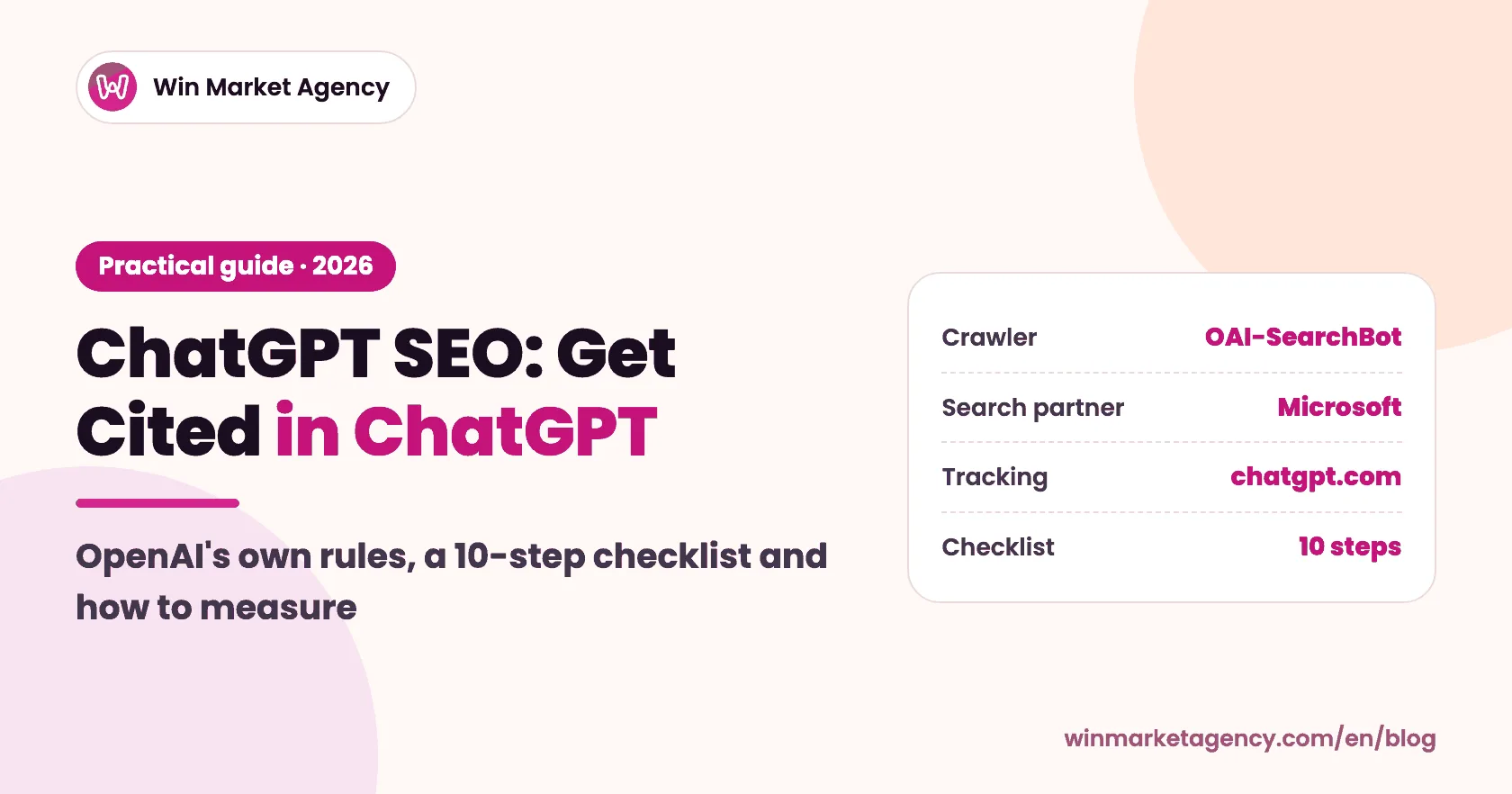
ChatGPT SEO is the work of making your site eligible, easy to read and worth quoting when ChatGPT searches the web. In practice: allow OpenAI's search crawler, OAI-SearchBot, make sure your firewall lets it in, be well indexed in the search engines ChatGPT queries, and publish pages that state facts plainly and early. OpenAI says placement is not guaranteed, so measure citations rather than assume them.
01How does ChatGPT search find and choose sources?
ChatGPT answers from two places: what its model learned in training, and what it finds by searching the web at the moment you ask. OpenAI's help centre says ChatGPT may search automatically "when your question would benefit from current information", and users can also start a search by hand.
When it searches, OpenAI says ChatGPT "sometimes partners with other search providers" and typically rewrites your question into one or more targeted queries. Its example: a long question about cancer drugs becomes a short query such as "CCR8 immunotherapy drug development 2025", followed by more specific follow-up queries. ChatGPT can also add your approximate location, so "restaurants near me" becomes "top restaurants San Francisco".
That has two practical consequences for ChatGPT search optimization:
- You compete on the rewritten query, not the long prompt. A page that clearly matches a short, specific query ("CRM pricing for small business 2026") has a better chance of being retrieved than one that only answers a vague topic.
- Local intent is made explicit. For a local business, the city and area name should be on the page, in plain text.
OpenAI's original launch post also says ChatGPT search "leverages third-party search providers, as well as content provided directly by our partners". It then ranks results "using multiple factors intended to help users find relevant, reliable information. Placement is not guaranteed."
02Training data vs. live search: two different routes into ChatGPT
The two routes are controlled by different OpenAI bots and change on very different timescales. Most confusion about how to rank in ChatGPT comes from mixing them up.
| Training data | Live search (ChatGPT search) | |
|---|---|---|
| What it is | Text a model learned from before release | Pages fetched and cited when a user asks |
| OpenAI bot | GPTBot | OAI-SearchBot |
| How fast your changes show | Only when a future model is trained | OpenAI says about 24 hours after a robots.txt change; content depends on recrawl |
| Does ChatGPT link to you? | No, there is no citation | Yes, citations and a Sources panel |
| Can you opt out separately? | Yes, disallow GPTBot | Yes, disallow OAI-SearchBot |
| What you can influence today | Little, and slowly | Access, indexing, page clarity, facts about your brand |
OpenAI's documentation on how its foundation models are developed says training uses publicly available internet content, data from third-party partners, and material from users and human trainers. It adds that website owners can opt out of training by disallowing GPTBot in robots.txt.
For a business, live search is where ChatGPT SEO happens. It is the route that cites and links to you, and the one you can affect this month.
03Which OpenAI bots should you allow?
Allow OAI-SearchBot if you want to appear in ChatGPT search answers; the other bots are separate decisions. OpenAI publishes four user agents, each with its own purpose and IP list:
| Bot | What OpenAI says it does | If you block it | Our default |
|---|---|---|---|
| OAI-SearchBot | Surfaces websites in ChatGPT's search features | Your pages are not shown in ChatGPT search answers, though they can still appear as navigational links | Allow |
| GPTBot | Crawls content that may be used to train foundation models | Signals that your content should not be used for training; search is unaffected | Business decision |
| ChatGPT-User | Visits a page when a user asks ChatGPT or a custom GPT to; not used for automatic crawling | It is user-initiated, so OpenAI says robots.txt rules may not apply | Leave alone |
| OAI-AdsBot | Checks the safety of landing pages submitted as ChatGPT ads | Only relevant if you advertise on ChatGPT | Allow if you run ads |
Three details most guides skip:
- Each setting is independent. You can allow OAI-SearchBot and disallow GPTBot. OpenAI says that if both are allowed it may use one crawl for both purposes.
- ChatGPT-User does not decide search inclusion. OpenAI says to use OAI-SearchBot in robots.txt to manage search opt-outs.
- robots.txt is not the only gate. OpenAI's help centre says to confirm that your website host or content delivery network allows traffic from its published searchbot IP addresses. A bot-protection rule on your CDN can block OAI-SearchBot even when robots.txt allows it.
A minimal robots.txt entry is two lines: "User-agent: OAI-SearchBot" followed by "Allow: /". If you have no rule naming OAI-SearchBot and no catch-all "Disallow: /", it is already allowed.
04Does ChatGPT use Bing? What is officially documented
OpenAI does not say "ChatGPT uses Bing" in its help documents, but it names Microsoft as one of its search providers. In the section on information shared with search providers, the help centre points users to two privacy policies: Microsoft's and Shopify's. Microsoft runs Bing; Shopify supplies product data for shopping results.
So the careful statement is this: ChatGPT search draws on third-party search providers, Microsoft is one of them, and OpenAI does not publish how much each provider contributes. Being properly indexed in Bing is therefore a sensible, low-cost step, not a guarantee.
Bing's own Webmaster Guidelines now cover AI answers directly. They say the same crawling, indexing and ranking foundation serves Bing search, Copilot and "grounding API results", and that following the guidelines helps URLs become eligible for "grounding results and citations". They also recommend IndexNow to notify Bing when URLs are added, updated or removed.
05A 10-step ChatGPT SEO checklist
Work through these in order. The first four are access; if any of them fails, nothing else matters.
- Allow OAI-SearchBot in robots.txt. Check every subdomain that serves content, not just the main site.
- Allow OpenAI's IP ranges at the CDN or firewall. OpenAI publishes them at openai.com/searchbot.json. Look in your CDN's bot or firewall logs for blocked requests with "OAI-SearchBot" in the user agent.
- Don't block Bingbot, and verify your site in Bing Webmaster Tools. Submit an XML sitemap that lists only canonical URLs with accurate lastmod dates, as Bing's guidelines ask.
- Turn on IndexNow. Bing recommends it for new, updated and deleted URLs, and its setup page explains how to add it.
- Put the answer first. Bing's guidelines say to place essential information near the top and avoid long introductions. Open each page with two or three sentences that answer its main question.
- Make every section stand on its own. Bing says pages are more likely to be selected for citations when "content stands on its own": explicit facts and definitions, no key statement that relies on implied context.
- One topic per URL. Bing says URLs focused on a primary topic are more likely to be selected. Align the title, headings and content.
- Use the same names everywhere. Bing asks for clear, consistent naming of people, organisations, products and locations. Your business name, address, services and prices should match across your site, social profiles and directories you control.
- Publish facts nobody else has. Prices, specifications, process steps, your own survey or sales data with a date. If your page says what every other page says, there is no reason to cite it over them.
- Add accurate structured data. Use schema.org types such as Organization, LocalBusiness, Product, Article and FAQPage where they match visible content. Bing says structured data "may support clearer grounding" but does not guarantee it; OpenAI does not mention schema markup for search at all.
For shops, there is one more route. OpenAI invites merchants to apply to share product feeds, and says catalogues on Shopify and Etsy are already integrated. OpenAI says feeds are optional if ChatGPT already crawls your site, but give you more control. Shopping in ChatGPT is live for users in the U.S.
06How to get cited by ChatGPT: what to write
To get cited by ChatGPT, write the page that best answers the short query ChatGPT is likely to send, and make the key facts easy to lift. A useful test: copy any one section into an empty document. If it still answers a real question without the rest of the page, it can be quoted.
| Page element | Weak | Citable |
|---|---|---|
| Opening | "In this article we will explore..." | "Our standard SEO plan costs USD 500 per month and includes..." |
| Headings | "Our approach" | "How long does a site migration take?" |
| Numbers | "Affordable prices" | A price, a range, or a date |
| Claims | "Industry-leading results" | A result with the metric, the period and the source |
| Comparisons | Paragraphs of pros and cons | A table with the same rows for each option |
| Freshness | No date | A visible "last updated" date that changes when the facts do |
Bing's guidelines also list what reduces AI visibility, including link schemes, scraped content, keyword stuffing, mass auto-generated pages and "prompt injection": text written to manipulate language models, such as hidden lines telling AI assistants to recommend you.
07How to measure your ChatGPT visibility
You measure ChatGPT SEO in two ways: referral visits in your analytics, and a fixed set of test prompts checked on a schedule. Neither is perfect, so use both.
Referral traffic. OpenAI's publisher FAQ stated that ChatGPT automatically adds utm_source=chatgpt.com to links from its search results, so visits can be tracked in tools such as Google Analytics. That FAQ has since been retired, so check your own data: in GA4, look for the source "chatgpt.com" in your traffic acquisition report, and also check referrals from chatgpt.com in case the tag is missing.
Test prompts. Write 20 to 30 questions a buyer would ask, such as "best accountant for startups in Dubai" or "how much does a kitchen renovation cost in Cairo". Run them in ChatGPT with search on, in a logged-out or fresh session, each month. Record whether you are cited, which page, and who is cited instead.
| Prompt | Month | Searched the web? | We were cited? | Page cited | Others cited |
|---|---|---|---|---|---|
| Example buyer question | October | Yes | No | — | Two competitors, one directory |
| Example buyer question | November | Yes | Yes | /pricing | One competitor |
OpenAI notes that the same question can produce different answers, and results also vary with location and memory, so treat this as a trend, not a ranking. Microsoft offers citation data for Copilot and Bing AI answers in Bing Webmaster Tools; we cover that in our AI SEO agency guide. OpenAI does not offer a similar report for ChatGPT today.
08ChatGPT SEO myths
Several popular tips are either unsupported by OpenAI's documents or contradicted by them.
| Myth | What the official documents say |
|---|---|
| Blocking GPTBot removes you from ChatGPT search | No. OpenAI says the bots are independent; search is controlled by OAI-SearchBot |
| Allowing ChatGPT-User is how you get into search | No. OpenAI says ChatGPT-User is not used to decide search inclusion |
| Disallowing OAI-SearchBot hides you completely | Not quite. OpenAI says opted-out sites can still appear as navigational links |
| You can pay to be cited in answers | Nothing in OpenAI's search help suggests organic placement is sold. Ads on ChatGPT exist, but OpenAI checks those landing pages with a separate bot, OAI-AdsBot |
| An llms.txt file is required | OpenAI's crawler and search documents don't mention it |
| Schema markup guarantees citations | Bing says structured data does not guarantee visibility; OpenAI doesn't mention it |
| Anyone can guarantee you'll appear | OpenAI says placement is not guaranteed; Bing says GEO "does not guarantee grounding or citations" |
09Do you need an agency for ChatGPT SEO?
Not for the access steps; you can do those in an afternoon. The slower work is rewriting key pages answer-first, publishing original facts, fixing inconsistent business details and tracking citations monthly. If you want help, our guide to choosing an AI SEO agency has a vetting table and a 90-day plan to hold any provider to.
10Where Win Market Agency fits
We are an SEO agency in Cairo, Egypt, working remotely with clients worldwide. Our SEO service covers Google and AI search, including ChatGPT, for USD 500 per month, and our SEO audit is free. The audit includes checking whether OpenAI's search crawler can actually reach your pages.
The same fundamentals drive both kinds of search. In one case, a property site grew from 39 to about 200,000 monthly organic visits after we replaced a spam link profile (case study). In another, a site that lost 21,000 keywords in 30 days went from 54,900 to 102,000 ranking keywords (case study).
Run these checks on us too: ask any provider, including us, to show the robots.txt, CDN and Bing checks on their own site before you hire them. Then contact us if you want the free audit.
?Frequently asked questions
What is ChatGPT SEO?
ChatGPT SEO is optimising a website so ChatGPT search can find it, read it and cite it. It covers allowing OAI-SearchBot, being indexed by the search providers ChatGPT uses, writing answer-first pages with clear facts, and measuring citations and referral traffic.
How do I rank in ChatGPT?
ChatGPT does not publish a ranking list, but you can make your site eligible and citable. Allow OAI-SearchBot in robots.txt and at your CDN, get indexed in Bing, answer the main question at the top of each page, keep your business details consistent, and publish original facts. OpenAI says placement is not guaranteed.
Does ChatGPT use Bing for search?
OpenAI says ChatGPT search uses third-party search providers and names Microsoft among them, but it doesn't say Bing is the only source or how results are weighted. Being indexed in Bing is a reasonable step, not a guarantee.
How long does it take to show up in ChatGPT?
OpenAI says a robots.txt change takes about 24 hours to reach ChatGPT search. New or rewritten pages appear once they are crawled and indexed, which varies. What a model learned in training only changes when a new model is trained.
Should I block GPTBot?
It depends on whether you are comfortable with your content being used to train OpenAI's models. Blocking GPTBot does not affect ChatGPT search, which is controlled by OAI-SearchBot, so you can block one and allow the other.
How can I see traffic from ChatGPT in Google Analytics?
Look for the source "chatgpt.com" in GA4's traffic acquisition report. OpenAI has said ChatGPT adds utm_source=chatgpt.com to links from search results. Check referrals from chatgpt.com too, and pair this with a monthly set of test prompts.
Can I pay to appear in ChatGPT answers?
OpenAI's help centre says ChatGPT ranks search results using multiple factors and that placement is not guaranteed; it describes no paid route into organic answers. ChatGPT ads are a separate product, with landing pages checked by OAI-AdsBot.
Want to know what's holding your site back?
Get a free SEO audit: where you rank, what's blocking you on Google and in AI answers, and what to fix first. SEO is USD 500 a month, and the audit is free.
Sources
- Overview of OpenAI crawlers — OpenAI
- Searching the web with ChatGPT — OpenAI Help Center
- Introducing ChatGPT search — OpenAI
- How ChatGPT and our foundation models are developed — OpenAI Help Center
- Bing Webmaster Guidelines — Microsoft Bing
- Power product discovery in ChatGPT — OpenAI
- Organization — schema.org
See Win Market first on Google
Add us as a preferred source and our new guides will be more likely to show up in your Google results and AI answers.