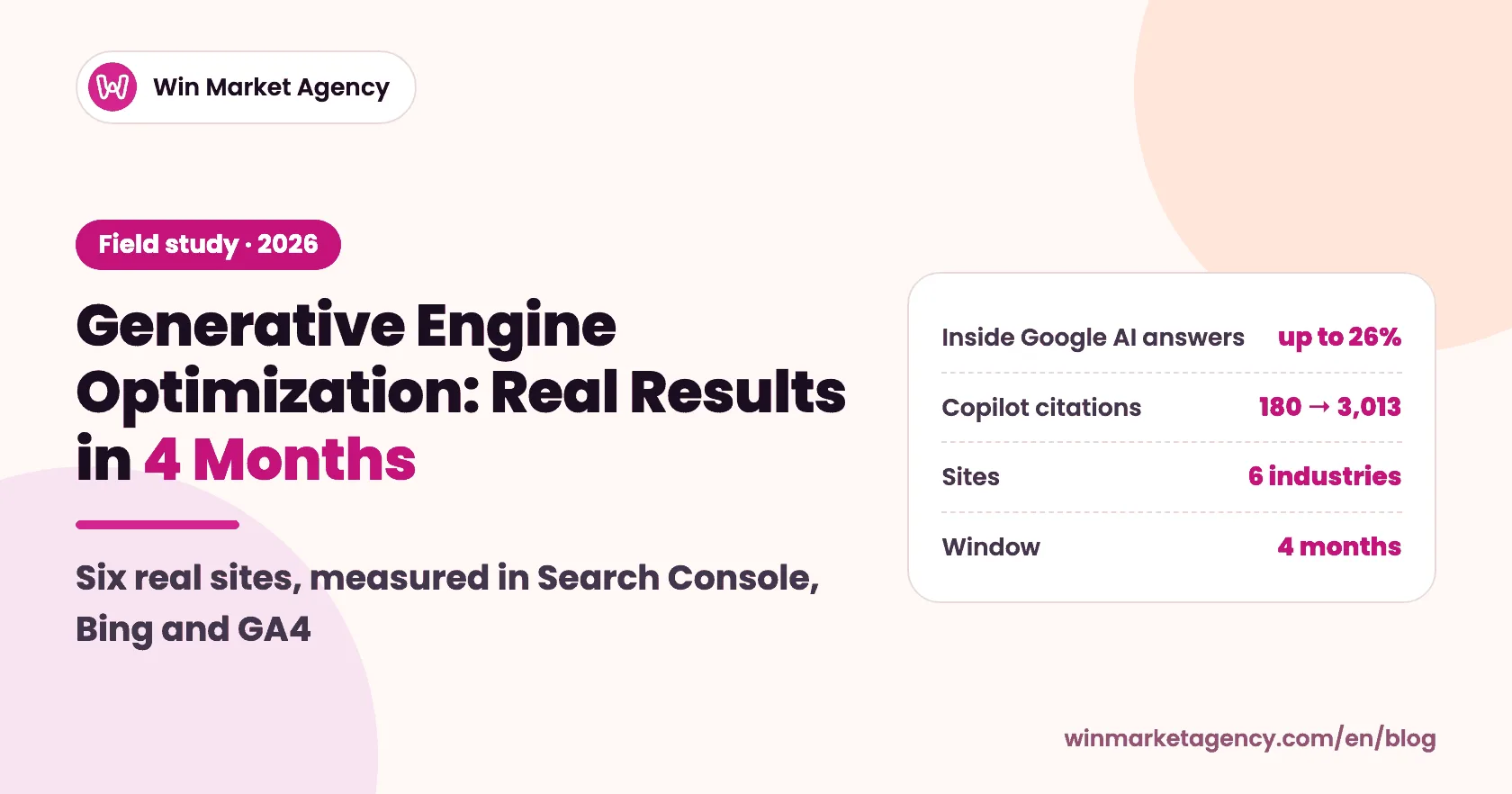
Generative engine optimization (GEO) is the work of making your pages the source that AI answers quote: Google's AI Overviews and AI Mode, Copilot, ChatGPT search and Gemini. It is not a separate trick. Across six sites we worked on, the ones that grew on Google in four months were the same ones that started appearing inside AI answers. On five of them, between 12% and 26% of all Google impressions now happen inside AI Overviews and AI Mode, and one software product went from 180 to 3,013 Copilot citations a month.
01What is generative engine optimization?
Generative engine optimization is optimising content so that generative AI systems retrieve it, trust it and cite it when they write an answer. The term comes from a 2023 research paper by Princeton and IIT Delhi researchers, which found that adding statistics, quotations and clear sources to a page could raise its visibility in AI answers by up to 40%.
The practical definition is simpler. An AI answer engine runs a search, reads a handful of pages, and writes a summary with links. GEO is everything that makes your page one of those few: being indexed, being easy to read, and saying something specific enough to quote.
02GEO vs SEO vs answer engine optimization
The three overlap far more than vendors suggest. What changes is who you are convincing and how you measure it.
| SEO | Answer engine optimization (AEO) | Generative engine optimization (GEO) | |
|---|---|---|---|
| Who picks you | Google and Bing ranking systems | The answer box, featured snippet or voice answer | The AI model writing a multi-source answer |
| What wins | Relevance, quality, links, technical health | One clear, direct answer to one question | Specific facts, numbers and sources it can quote |
| How you measure it | Search Console clicks, impressions, position | Snippet and People Also Ask appearances | Search Console's Generative AI report, Bing AI citations, GA4 AI Assistant visits |
| Can it work alone? | Yes | Rarely | No: AI retrieves from search indexes first |
The last row is the one that matters. Google's own guide to generative AI features says optimising for them is still optimising for Search, and OpenAI's help centre names Microsoft as ChatGPT's web search provider. If a page is not indexed and trusted, no AI model will find it to cite it.
03How we measured: four tools, no guesswork
We used only first-party dashboards, and we started each window in the first month of our work, when the curve turned.
- Google Search Console: monthly clicks, impressions and the queries each site appeared for.
- Search Console → Generative AI: impressions of the site inside AI Overviews and AI Mode only, over the last three months. This is the most important number in this study, and most site owners have never opened it.
- Bing Webmaster Tools → AI Performance: citations of the site in Microsoft Copilot, Bing's AI summaries and Microsoft's partners, plus the "grounding queries" the AI searched before citing, and the site's citation share for each one.
- GA4: real visits from chatgpt.com, gemini.google.com, copilot.com and perplexity.ai, grouped into an "AI Assistant" channel.
What we cannot measure, we do not claim. There is no official ChatGPT or Claude console that reports citations. Microsoft does not name the partners behind its numbers, so we treat Bing's figures as Copilot data and use GA4 to show ChatGPT separately.
04The results: six sites, six industries
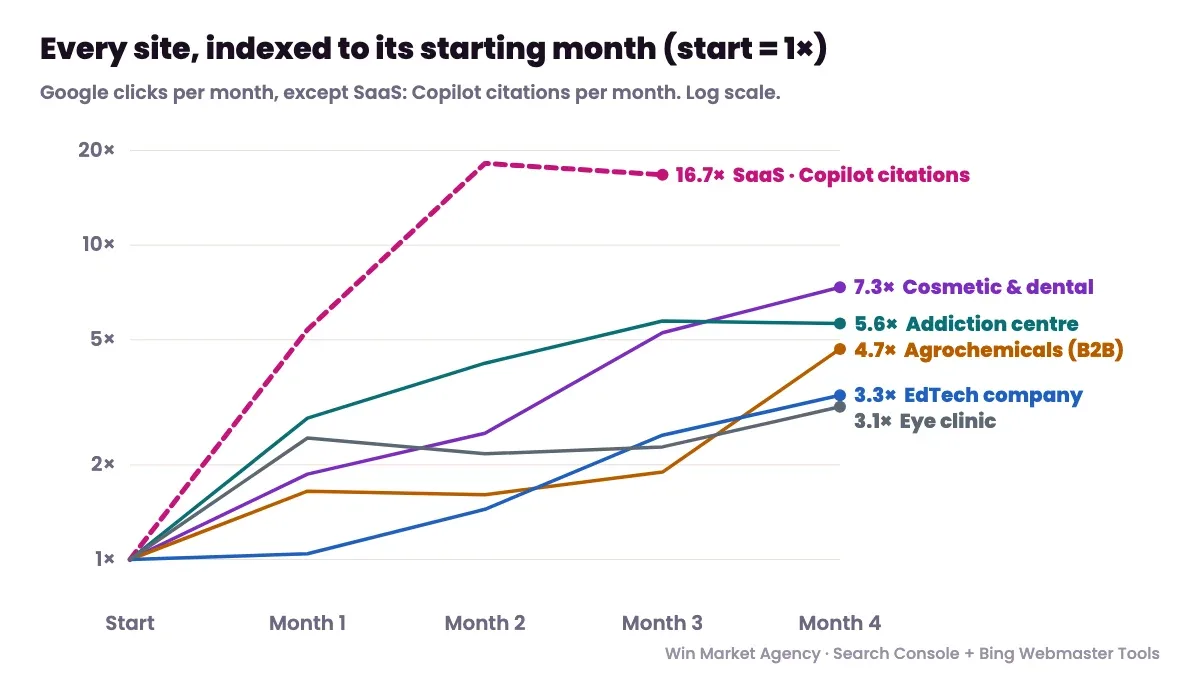
| Industry | Google clicks / month | Inside Google's AI answers (last 3 months) | Share of the site's Google impressions |
|---|---|---|---|
| Cosmetic and dental centre | 23 → 169 | 9,960 | 26% |
| Agrochemicals company (B2B) | 117 → 547 | 15,700 | 25% |
| Eye clinic (after a core update drop) | 202 → 618 | 26,600 | 24% |
| EdTech company (B2B) | 319 → 1,062 | 25,000 | 15% |
| Psychiatric and addiction treatment centre | 38 → 214 | 5,300 | 12% |
| Agency software (SaaS, global, English) | 7 → 50 | 1,590 | — |
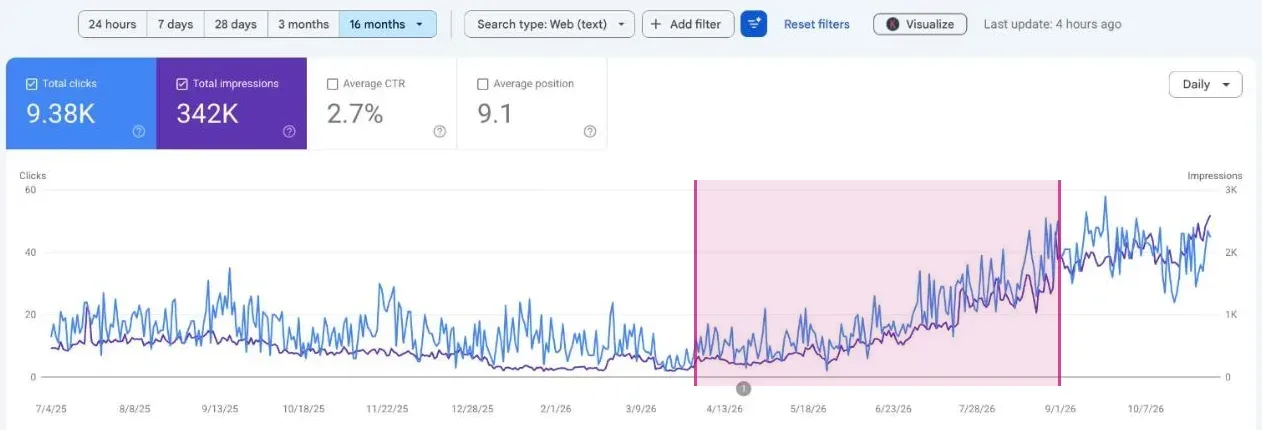
Clicks compare each site's starting month with the month four months later; for the SaaS site they are two-month totals (June and July against September and October), because its monthly numbers are small. The AI figures come from Search Console's Generative AI report and are part of total impressions, not extra to them. The SaaS site barely appeared in Google's AI answers before 25 September 2026; its AI story is on Copilot, where citations rose from 180 to 3,013 a month.
05The number most sites never check: Google's Generative AI report
Search Console now has a report that counts impressions inside AI Overviews and AI Mode on their own. On our six sites it changed how we read everything else: a quarter of a clinic's Google visibility was happening inside AI answers, and nothing in the standard Performance report said so.
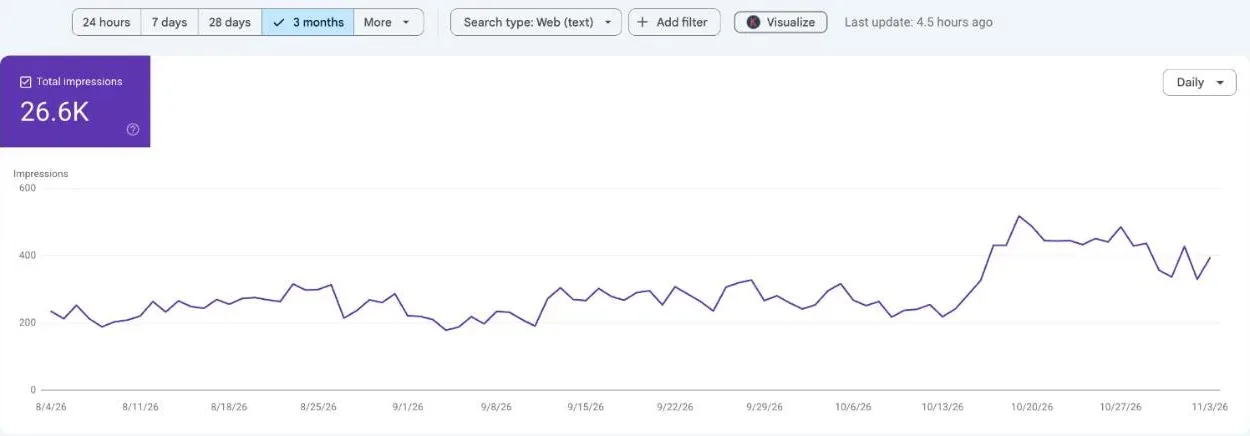
The same data explains some strange queries. On four of the six sites, Search Console listed conversational replies as queries: "yes" (in Arabic, نعم) between 20 and 41 times, "how much" (بكام), "how much is it", and on the agrochemicals site "yes, yellowing" (نعم اصفرار). Nobody opens Google and types "yes". Google's Search Console help says a follow-up question inside AI Mode counts as a new query, so these sites were being shown inside real conversations with Google's AI.
06The 4-Month Citation Method
We call it the 4-Month Citation Method because it is built to end in one thing: being the page an AI answer quotes. Each month has one job, and the order matters, because AI can only cite what search engines have already found and trusted.
- Month 1: be findable. Open the site the way a machine does: the HTML the server sends before any JavaScript runs, indexing, redirects. Allow search and AI crawlers, submit sitemaps to Google and Bing, and switch on IndexNow. Then map every question buyers ask, in their own words, spellings and dialect.
- Month 2: answer, don't describe. One question per page. The answer in the first two sentences, then the evidence: numbers, prices, steps, a table. This is answer engine optimization in practice.
- Month 3: be trustworthy. A named expert who wrote or reviewed the page, a real update date, sources, structured data where it fits, and one page per question instead of several competing duplicates.
- Month 4: measure and widen. Read the Generative AI report, the grounding queries in Bing and the AI Assistant channel in GA4. Expand the topics that are already cited and fix the pages that are seen but not clicked.
07Case 1: a SaaS product cited 3,000 times a month
Before: an agency-management software product, selling in English worldwide, with 180 Copilot citations in all of July 2026. After four months: 969 citations in August, 3,275 in September and 3,013 in October; 7.8K in six months, with 59 different pages cited.
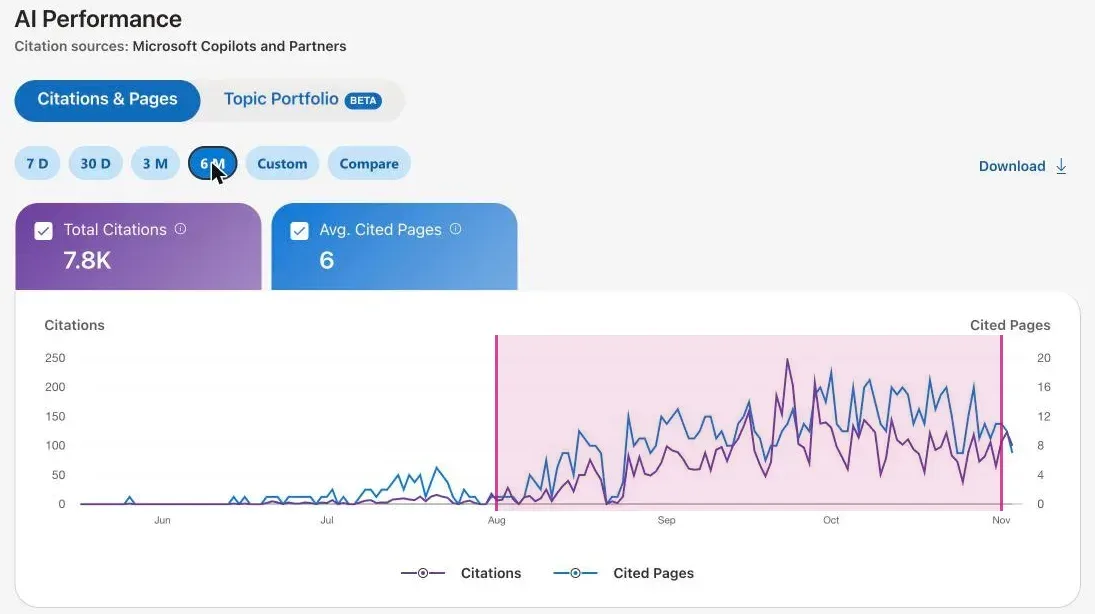
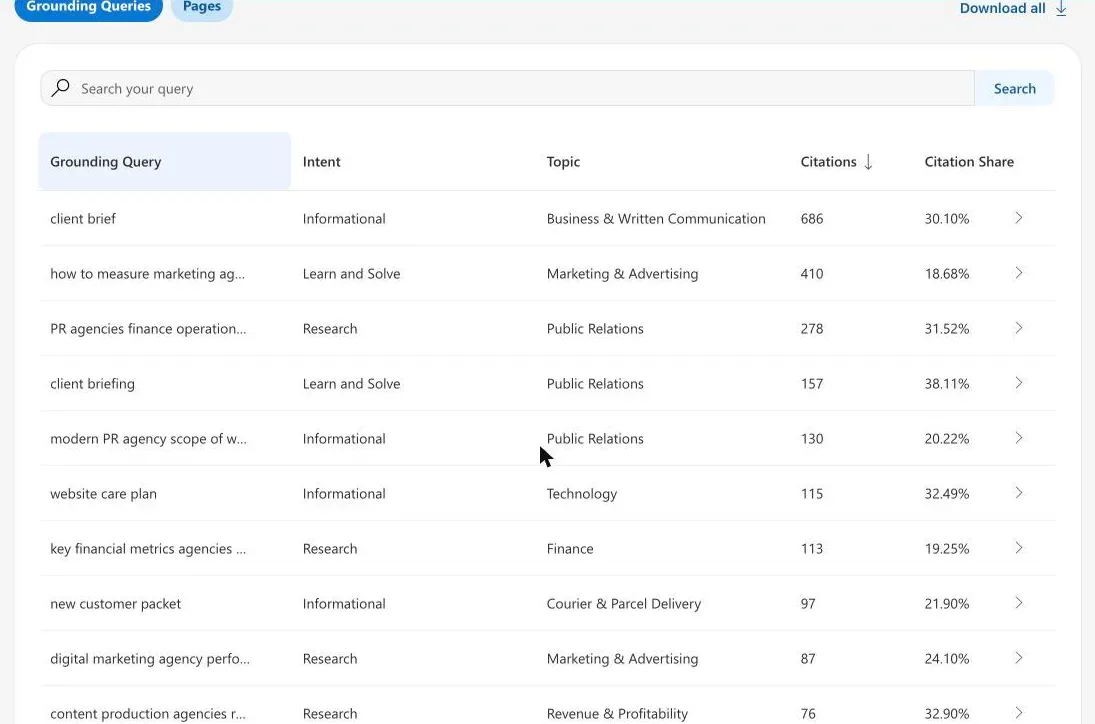
What the data shows. The pages Copilot cites share three shapes: a template someone can copy (client brief, scope of work, freelance contract), a page of benchmark numbers, and a head-to-head comparison of two named tools. The two most-cited pages are a guide to agency growth metrics and the client brief template. The home page, the pricing page and the feature pages were cited by nobody.
| Grounding query | Citations | Citation share |
|---|---|---|
| client brief | 686 | 30.1% |
| how to measure marketing agency performance | 410 | 18.7% |
| PR agencies finance operations benchmark data | 278 | 31.5% |
| client briefing | 157 | 38.1% |
| website care plan | 115 | 32.5% |
Cited, not clicked. Over the last three months, the same site earned 18 clicks from Bing's normal search results and about 7,500 Copilot citations. Many of the "searches" in its Bing report were not typed by people at all: boolean strings, pasted prompts, file paths. That is what AI retrieval looks like from the inside. If you judge GEO by clicks alone, you will miss most of it.
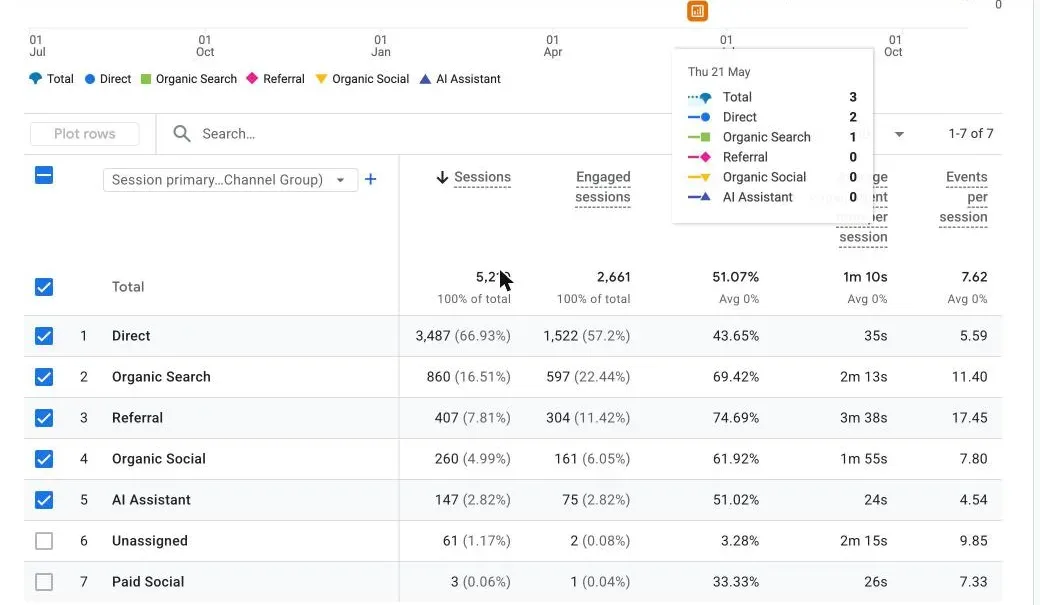
On Google, clicks went from 7 in June and July to 50 in September and October, and impressions from 426 to 9,310. The ChatGPT side shows up in GA4: since tracking began, chatgpt.com sent 145 sessions, more than Bing's organic search (106).
How we work on a site like this. For software, the buyer's question comes long before the product search. We build the pages a customer needs to do their job (templates, checklists, benchmarks, honest comparisons) and let the product appear inside them as the tool that does it faster. Feature pages stay, but they are not where AI finds you. More in our guide to SEO for SaaS.
Read the full SaaS case study (in Arabic)
08Case 2: an EdTech company, on Google and in AI together
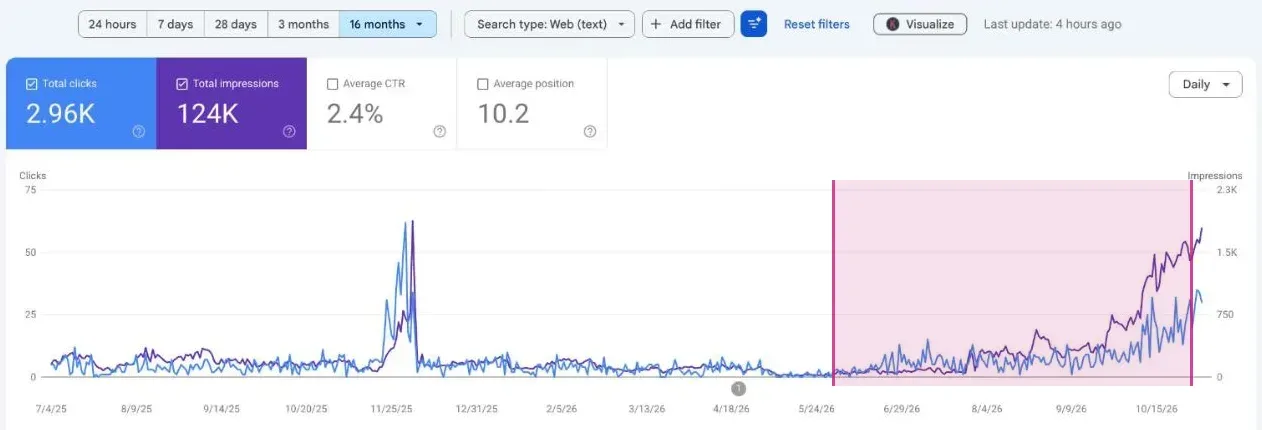
Before: a B2B EdTech company selling interactive classroom screens, sliding for six months, from 580 clicks in September 2025 to 240 in March 2026. After four months: clicks rose every month, 319, 333, 461, 793, then 1,062 in August. Impressions went from 7.7K to 43.2K and kept climbing to 63.9K in October. In the last three months, 25,000 of its Google impressions, about 15%, were inside AI answers.
Copilot followed, with 2,600 citations and about seven of its pages cited every day.
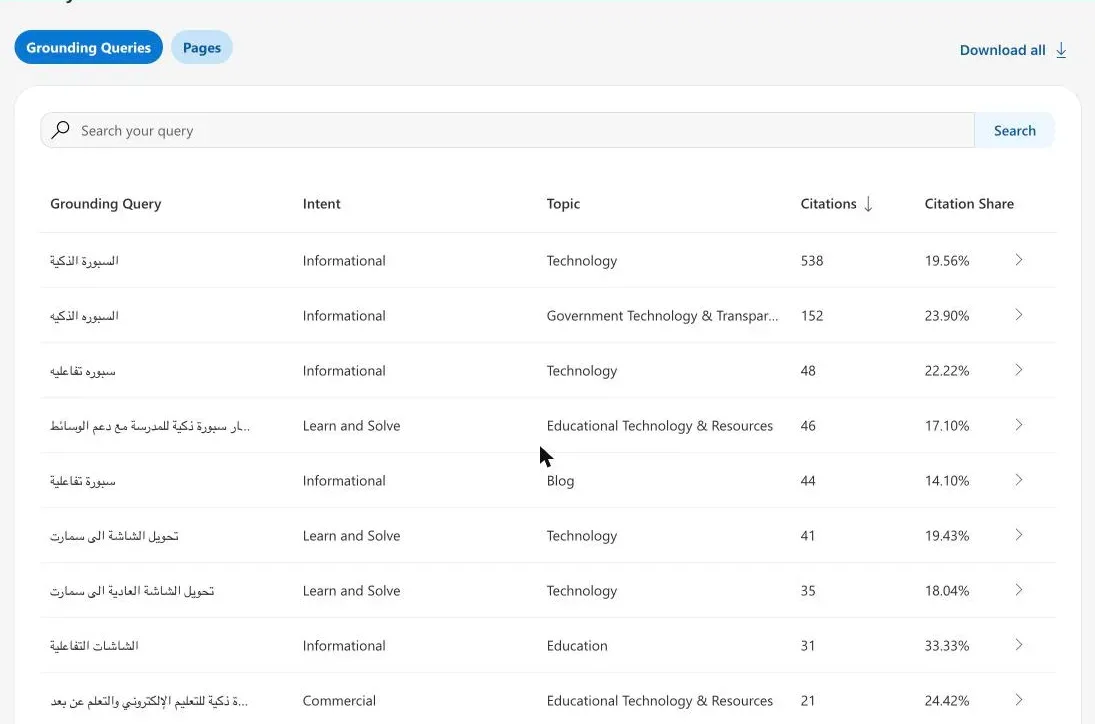
What the data shows. The grounding queries reveal something most Arabic sites miss: Copilot searched the same product in several spellings, and counted each one separately.
| Grounding query (Arabic) | Meaning | Citations | Share |
|---|---|---|---|
| السبورة الذكية | the smart board | 538 | 19.6% |
| السبوره الذكيه | same, colloquial spelling | 152 | 23.9% |
| سبوره تفاعليه | interactive board | 48 | 22.2% |
| تحويل الشاشة الى سمارت | turn a screen into a smart screen | 41 | 19.4% |
| الشاشات التفاعلية | interactive screens | 31 | 33.3% |
How we work on a site like this. B2B buyers search by problem and category before brand: "smart board for schools", "turn a TV into a smart screen", "how much". We build a page per category and per problem, with specifications, sizes, prices, use cases and a comparison table, written in the words schools and offices actually type, including the common spellings.
Read the full EdTech case study (in Arabic)
09Case 3: the cosmetic and dental centre AI could not see
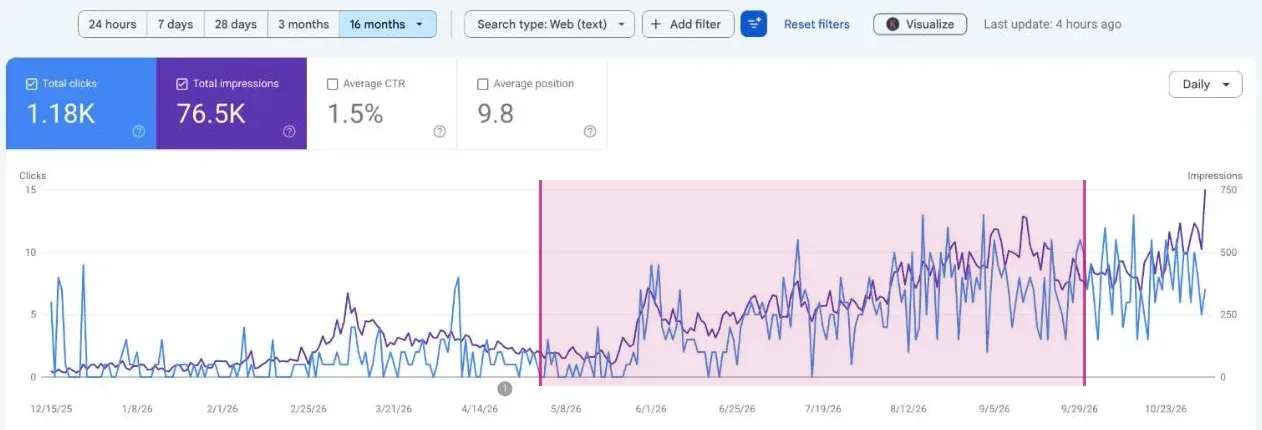
Before: 4 clicks from Google in April 2026. The site had services and articles, but it was built in an old JavaScript framework (AngularJS), so the HTML that reached crawlers had no title and 115 readable words. The heading literally read {{firstAddress}}. After four months: 169 clicks in September and 263 in October. The queries it appeared for went from 81 to 1,007, and 9,960 of its Google impressions in the last three months, about a quarter, were inside AI answers.
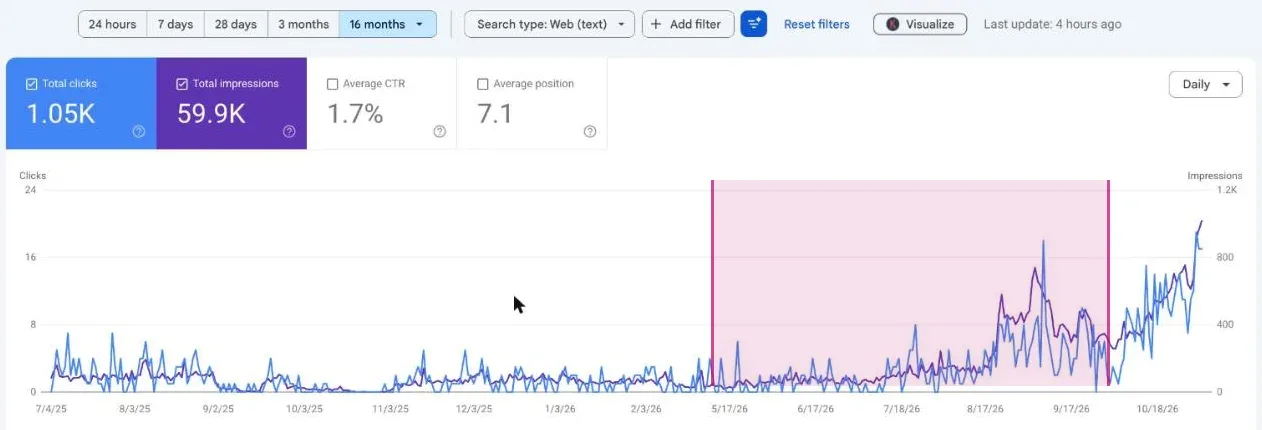
On Copilot, the centre has 1,100 citations in six months. For «تكلفة زراعة الاسنان في مصر» (cost of dental implants in Egypt), Bing reports a citation share of 50%: half of all the citations Copilot gave on that question went to this one site.
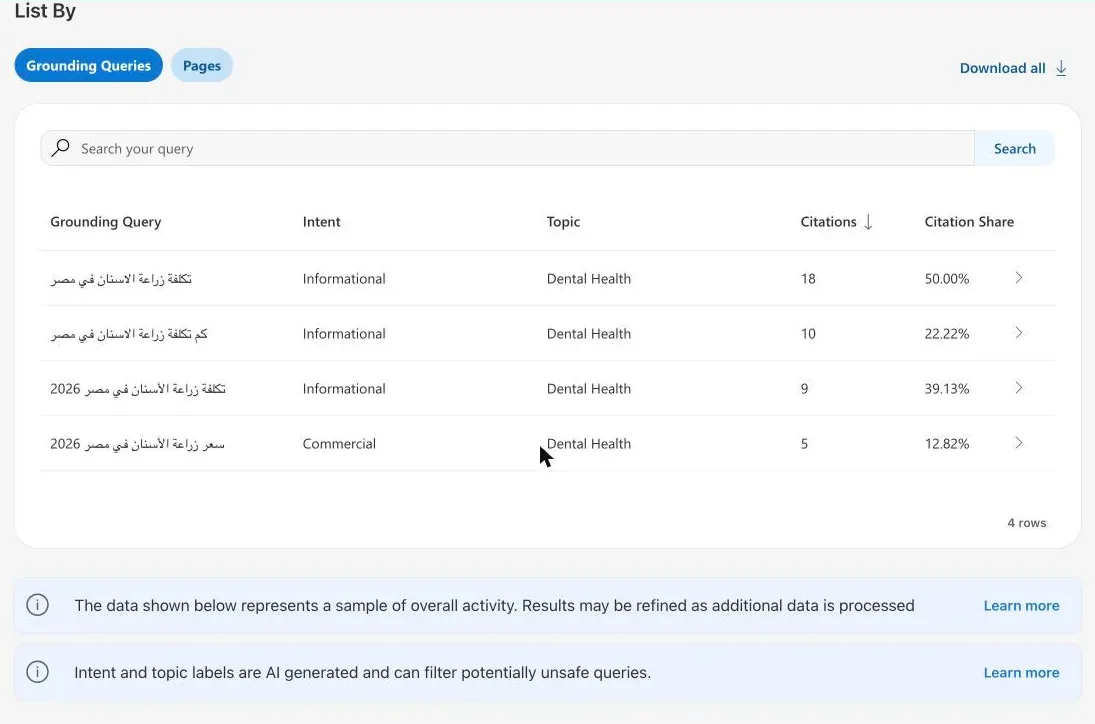
What the data shows. Every grounding query is a price question, in four phrasings: "cost of dental implants in Egypt" (50%), "how much do dental implants cost in Egypt" (22.2%), "dental implant cost in Egypt 2026" (39.1%) and "dental implant price in Egypt 2026" (12.8%). The year in the query matters: people, and the AI on their behalf, want this year's price.
How we work on a site like this. First, make sure machines can read the page at all: content in the HTML the server sends, not assembled later in the browser. Then patients ask about price, pain, duration and the doctor, in that order. Each gets a page that answers in the first two sentences with a real range and what moves it, then the doctor's credentials, then booking. Clinics that hide prices behind "contact us" give the AI nothing to quote.
Read the full case study (in Arabic)
10Cases 4 to 6 in brief
- Eye clinic, recovering from Google's May 2026 core update: daily impressions fell from 1,847 to 311 in five days. Nothing was broken. The same question had three competing pages, and medical articles were not under the doctor's name. We merged duplicates into one page per question and put every article under the doctor's byline and review, with a short summary at the top. Monthly clicks went from 202 in June to 618 in October, and 26,600 impressions in the last three months, about a quarter, were inside AI answers. Full story (in Arabic)
- Agrochemicals company (B2B): the site was a product catalogue, found only by people who already knew the product names. Farmers search for their problem: "why are my tomato leaves turning yellow". Diagnosis-first guides took impressions from 2.9K in May and June to 48.6K in September and October, and a quarter of the last three months' impressions were inside AI answers. Full story (in Arabic)
- Psychiatric and addiction treatment centre: families search for "the cheapest rehab". Most centres avoid the question. This one answers it honestly, explaining what drives the cost, and that page became the site's biggest, at an average position of 2.6. Clicks went from 94 in April and May to 432 in August and September. GA4 also records visits from ChatGPT and Gemini. Full story (in Arabic)
11We asked ChatGPT the same questions. Here is what happened
In November 2026 we put three of these grounding queries to ChatGPT in a temporary chat, so our account history could not bias it: the dental implant cost question, the best smart board for schools, and what a client brief should include. In all three, ChatGPT cited other sites, not our clients.
That result teaches three things:
- A citation share is a probability, not a seat. 50% means half the answers, not all of them. Ask once and you may land on the other half.
- Each engine picks its own way. For the SaaS questions, Copilot leans on templates and benchmarks, while Google often surfaces "best tools for…" lists instead.
- This is why we measure ChatGPT through GA4, not screenshots. The 145 ChatGPT visits to the software site are a fact. A single screenshot of one answer is an anecdote, in either direction.
12How to read Bing's AI Performance report
| Metric | What it means | What to do with it |
|---|---|---|
| Total citations | How many times AI answers linked to your site | Track the monthly trend, not the daily spikes |
| Average cited pages | How many of your pages were cited per day | A rising number means AI trusts more of your site |
| Grounding queries | What the AI searched before answering | Your real content brief: write for these |
| Citation share | Your share of all citations for that query | Above 20% means you are a default source |
| Pages | Which URLs were cited | Copy the shape of your top pages |
Bing labels the data a sample, and Microsoft does not name its partners, so read it as a strong signal for Copilot rather than a full count of all AI.
13Nine patterns behind the pages that get cited
- The answer sits in the first two sentences.
- It contains a number: a price, a duration, a percentage.
- It answers one question, not five.
- It starts from the buyer's problem, not the product.
- It uses the buyer's words, including local spellings and dialect.
- It has a table the AI can lift.
- It was indexed in both Google and Bing, with its content in the HTML the server sends.
- It names the expert who wrote or reviewed it, with a real update date.
- It came from a site that was already growing on Google. We did not see AI visibility rise on a site whose search traffic was falling.
14What AI does not cite
Pages without a direct answer, pages that hide prices behind "contact us", and thin pages written to stuff a keyword were not cited. AI visibility follows search health: when the eye clinic lost its Google traffic in late May 2026, its Copilot citations faded with it, and once it recovered on Google, its impressions inside Google's AI answers climbed too.
Google is explicit that no one can guarantee a ranking, and Microsoft offers no way to buy placement in Copilot answers. Anyone promising either is guessing.
15A checklist for how to do generative engine optimization yourself
| Check | Where | Pass |
|---|---|---|
| Important text is in the HTML before JavaScript runs | View source in your browser | Title, headings and copy are visible |
| Generative AI report has data | Search Console → Generative AI | Impressions inside AI answers |
| Site verified in Bing Webmaster Tools | bing.com/webmasters | AI Performance shows data |
| OAI-SearchBot and Bingbot allowed | robots.txt and firewall | Not blocked |
| One page per question | Your site's page list | No two pages on the same topic |
| Answer in the first two sentences | Each key page | Yes |
| At least one number per answer | Each key page | Yes |
| Expert's name on specialist content | Articles | Yes |
| AI Assistant channel in GA4 | Reports → Traffic acquisition | Visible |
If you want the same work done for you, our SEO service covers Google and AI search together, and the first audit is free. For ChatGPT specifically, read our ChatGPT SEO guide.
16Where Win Market Agency fits
We are a Cairo-based agency that does SEO and generative engine optimization for clients in Egypt, the Gulf and abroad, in Arabic and English. SEO is USD 500 a month, and the SEO audit is free. We show results the way this article does: dated screenshots from Google, Bing and GA4, with the window marked. Ask any agency, including us, for the same.
?Frequently asked questions
What is generative engine optimization in simple terms?
It is making your pages the ones AI tools quote. AI answer engines search the web, read a few pages and summarise them with links. GEO makes your page indexed, easy to read and specific enough to be among those few.
Is GEO different from SEO?
Partly. GEO is built on SEO, because AI systems retrieve pages from search indexes first. What GEO adds is writing for quotation: direct answers, numbers and sources, and measuring visibility inside AI answers, not only clicks.
How do I see if my site appears in Google's AI Overviews?
Open the Generative AI report in Google Search Console. It counts your impressions inside AI Overviews and AI Mode separately. On five of the six sites in this study, those impressions were between 12% and 26% of all Google impressions over three months.
How long does generative engine optimization take?
In our data, the change was clear within four months. A software site went from 180 to 3,013 Copilot citations a month between July and October 2026, and an agrochemicals company's Google impressions rose from 2.9K to 48.6K over two-month windows.
Can I see if ChatGPT cites my website?
Not directly: OpenAI offers no citation console. You can see visits from chatgpt.com in GA4's AI Assistant channel, and links from ChatGPT carry utm_source=chatgpt.com. Bing's AI Performance report shows Copilot citations.
Does Bing Webmaster Tools show ChatGPT citations?
Microsoft says the report covers Copilot, Bing's AI summaries and select partners, but it does not name the partners. Treat the figures as Copilot data and measure ChatGPT through GA4.
Why does my site get AI citations but no clicks?
Because the AI answers the question on its own page. In our software case, Copilot cited the site about 7,500 times in three months while Bing search sent 18 clicks. Judge GEO by AI impressions, citations, AI Assistant visits and enquiries, not clicks alone.
Can an agency guarantee AI citations?
No. Google warns against anyone who guarantees rankings, and no AI company sells or promises citations. An agency can show you dated proof of what it achieved for others.
Want to know what's holding your site back?
Get a free SEO audit: where you rank, what's blocking you on Google and in AI answers, and what to fix first. SEO is USD 500 a month, and the audit is free.
Sources
- GEO: Generative Engine Optimization — Aggarwal et al., arXiv
- Optimizing your website for generative AI features on Google Search — Google Search Central
- Generative AI performance report (Search) — Search Console Help
- What are impressions, position, and clicks? (AI Mode follow-ups) — Search Console Help
- Introducing AI Performance in Bing Webmaster Tools Public Preview — Bing Webmaster Blog
- Searching the web with ChatGPT — OpenAI Help Center
- Overview of OpenAI crawlers — OpenAI Platform
- Do you need an SEO? — Google Search Central
See Win Market first on Google
Add us as a preferred source and our new guides will be more likely to show up in your Google results and AI answers.