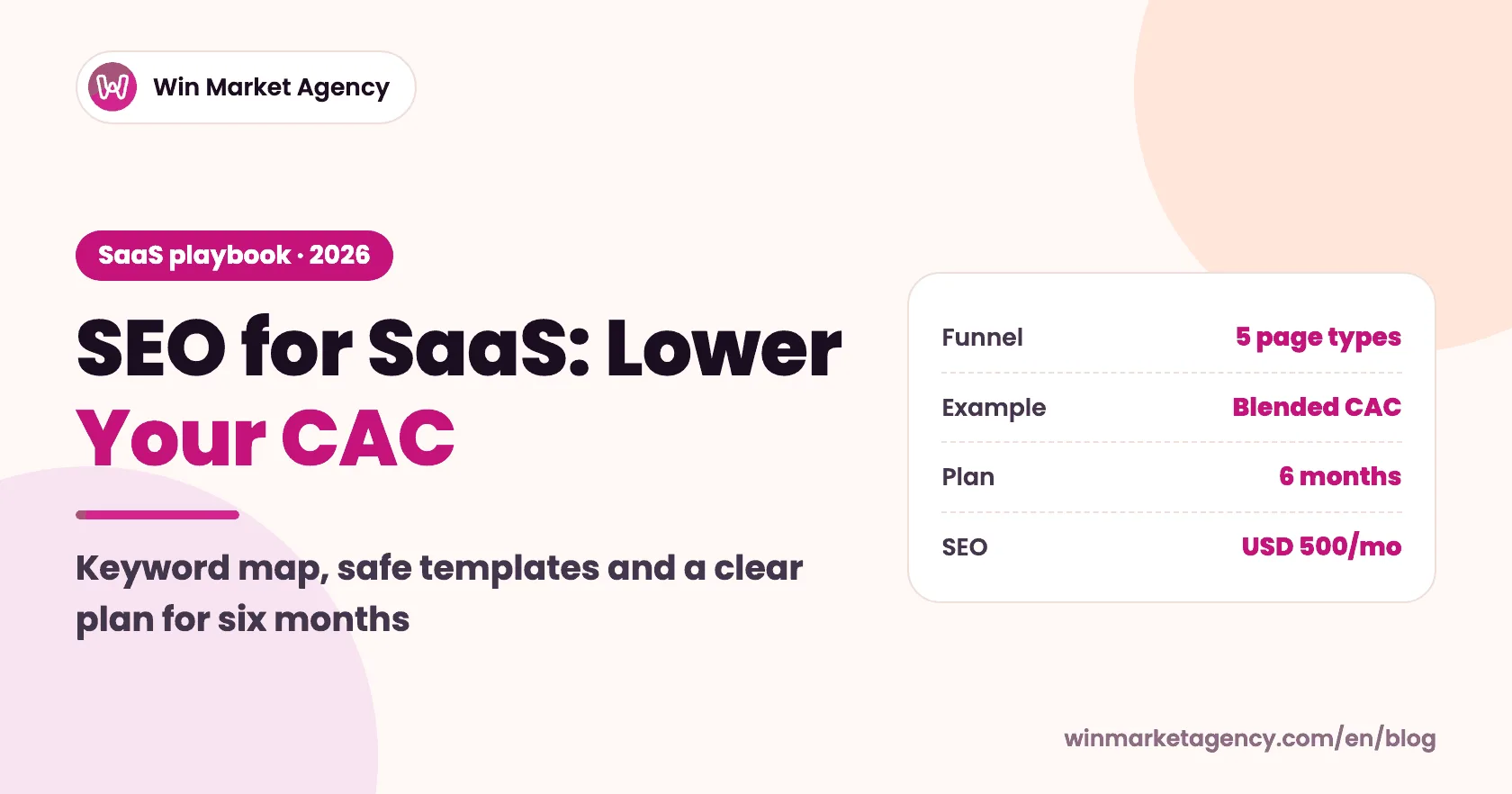
SEO for SaaS means ranking the pages software buyers search at every stage, from the problem they have to "your product vs a rival", and turning that traffic into trials and signups. Build bottom-of-funnel pages first (comparisons, alternatives, integrations), make sure Google can render your JavaScript, scale templates only when each page adds real value, and report organic signups and CAC payback, not traffic.
01What is SEO for SaaS, and how is it different?
SEO for SaaS is ordinary SEO applied to a product sold by subscription, usually tried before it is bought, and researched by several people. Three things differ in practice.
- The product is behind a login. Most of your value lives in the app, which Google cannot see. Your marketing site, docs and templates have to carry the search demand.
- Buyers compare. Software buyers search "best X for Y", "A vs B" and "A alternatives" before they sign up. Those searches are where shortlists are made.
- The goal is recurring revenue. A signup is only a start. The right measure is how many organic signups become paying accounts, and how quickly they pay back what it cost to win them.
02The SaaS keyword map: five page types by funnel stage
A SaaS keyword map groups searches by what the buyer is trying to do, and gives each group a page type. Build from the bottom of the funnel up, because those pages convert first.
| Funnel stage | Page type | Example search | What the page must do |
|---|---|---|---|
| Problem (top) | Guide or how-to article | "how to reduce invoice late payments" | Solve the problem honestly, then show where the product helps |
| Solution (middle) | Category or use-case page | "invoicing software for agencies" | Explain who it is for, key workflows, pricing and proof |
| Comparison (bottom) | "vs" and "alternatives" pages | "ToolA vs ToolB", "ToolA alternatives" | Fair, dated comparison with a clear "choose us if / choose them if" |
| Integration (bottom) | One page per integration | "invoicing software that integrates with Xero" | Show what syncs, setup steps, limits and a screenshot |
| Template (middle to bottom) | Templates, calculators, examples | "freelance invoice template" | Give a usable asset free, with a natural step into the product |
Start with your own data: sales call notes, support tickets and Search Console queries. The words customers use there are the keywords that convert.
How to write comparison and alternatives pages that rank and convert
Comparison pages work when they are fair, because buyers have usually read the rival's site already. Date the page, compare on what buyers weigh (price, features, integrations, support, data export), say plainly who should pick the other product, and update it when either product changes.
03Programmatic SEO for SaaS: how to scale pages without breaking Google's rules
Programmatic SEO is safe when every generated page answers a real search with information the user cannot get from the page next to it. Google's spam policies define scaled content abuse as many pages generated "for the primary purpose of manipulating search rankings" rather than helping users, whether they are made by people, automation or generative AI.
Integration, template and "X for [industry]" pages suit templates. The risk is a thousand pages that differ by one swapped word. Before you publish a batch:
- Prove demand per page. Check that people actually search each variant. Skip combinations with no real query behind them.
- Give each page unique data. Real setup steps, screenshots, field mappings, limits and examples for that integration or industry. If the only difference is the name, do not build the page.
- Publish a small pilot. Release 20 to 50 pages, then check in Search Console whether they are indexed, shown and clicked before scaling.
- Review a sample by hand. Read ten pages as a buyer would. If they read like filler, Google's helpful content guidance says the same thing: content made "primarily to attract visits from search engines" is the wrong target.
- Prune what fails. Merge or remove pages that get no impressions after a few months, so they do not dilute the rest of the site.
| Safe programmatic page | Risky programmatic page |
|---|---|
| Integration page with real sync details and setup steps | Same paragraph with a different app name swapped in |
| Template page with a downloadable, working template | Page that only describes a template that does not exist |
| Industry page with that industry's workflow and examples | "Best software for [city]" pages with no local relevance |
| Built from your own product data | Scraped or spun from other sites |
04Product-led content: let the product do the explaining
Product-led content solves the reader's problem by showing the product doing it. Instead of a generic article on "how to plan a sprint", show the sprint board, the steps in your tool, and the result. The reader sees the product working before they sign up.
Formats that work: tutorials with real screenshots, free templates and calculators usable without an account, use-case pages built from customer workflows, and anonymised data from your own product that others will cite. Specific, factual pages like these are also easier for AI assistants to quote; see our guide to ChatGPT SEO.
05Technical SEO problems specific to SaaS sites
Most SaaS technical problems come from the product's technology leaking into the marketing site: JavaScript frameworks, subdomains and app pages that should never be indexed.
JavaScript rendering. Google processes JavaScript pages in three phases: crawling, rendering and indexing. Rendering waits until Google's resources allow, and Google's own JavaScript SEO guide still recommends server-side rendering or pre-rendering because it makes a site faster for users and crawlers, and not every bot runs JavaScript. For a marketing site built on React, Vue or similar, render key pages on the server or generate them statically.
Links and routing. Google discovers links only from HTML <a> elements with an href. Buttons with click handlers are invisible to it. Use the History API for client-side routes, not # fragments.
Soft 404s. Single-page apps often return a 200 status for pages that do not exist. Google's guide suggests either a JavaScript redirect to a URL that returns a real 404, or adding a noindex tag to error pages.
Docs on a subdomain. Documentation on docs.example.com can rank well, but it is often missed in reporting. Set up a Search Console Domain property, which covers all subdomains and protocols, so docs, blog and main site are measured together. Link from docs to the relevant product and integration pages.
App vs marketing site. Keep login, dashboard and staging pages out of the index; keep the public marketing site crawlable.
| Check | How to test it | Fix |
|---|---|---|
| Content visible without JavaScript | Search Console URL Inspection, view the rendered HTML | Server-side rendering or static generation |
| Crawlable links | Look for <a href> in the rendered HTML | Replace click handlers with real links |
| Soft 404s | Request a fake URL and check the status code | Return 404, or noindex the error view |
| Docs measured | Is there a Domain property in Search Console? | Add one; link docs to product pages |
| App pages out of the index | site: search for login and app URLs | noindex, or block in robots.txt once deindexed |
| Staging not indexed | site: search for staging domains | Password-protect staging |
If you are not sure where your site stands, start with a full SEO audit.
06Organic growth and CAC reduction: how SEO lowers blended CAC
SEO lowers blended customer acquisition cost (CAC) because organic signups keep arriving without a cost per click, so as they grow, the average cost of every new customer falls. Blended CAC is total acquisition spend divided by all new customers, from every channel.
The table below is an illustrative example, not data from a client. It shows the arithmetic for a SaaS product with paid ads held flat while organic grows over a year.
| Example figures (illustrative only) | Month 1 | Month 12 |
|---|---|---|
| Paid ads spend | USD 30,000 | USD 30,000 |
| New customers from paid | 100 | 100 |
| Paid CAC | USD 300 | USD 300 |
| Total SEO programme cost (agency fee plus writers, developers and tools) | USD 3,000 | USD 4,000 |
| New customers from organic | 10 | 60 |
| Blended CAC (total spend ÷ all new customers) | USD 300 | USD 213 |
| CAC payback at USD 80 gross margin per account per month | 3.8 months | 2.7 months |
Two honest notes. Organic is not free: count writers, developers, design and tools in the SEO cost. And the gain is slow: in early months organic CAC can exceed paid, because you pay for content before it ranks.
07Which SaaS SEO metrics to report every month
The metrics that matter are the ones finance can check: signups, paying accounts and payback from organic search. Rankings and traffic explain why those numbers moved, but they are not the result.
| Metric | Why it matters | Where it comes from |
|---|---|---|
| Organic signups or trials | The first real outcome of SEO | GA4 key event, landing page = organic |
| Organic signup-to-paid rate | Shows whether the traffic is the right audience | Product analytics or CRM |
| New paying accounts from organic | The number that changes revenue | CRM with first-touch or self-reported source |
| Blended CAC and CAC payback | Shows the effect on unit economics | Finance, using the formula above |
| Signups by page type | Shows which part of the keyword map works | GA4, grouped by URL folder |
| Non-branded clicks and impressions | Leading indicator of new demand | Google Search Console |
Mark signup and trial start as key events in GA4. Add a "How did you hear about us?" field at signup too: it catches Google and AI-answer discovery that analytics loses.
08A 6-month SEO plan for a SaaS company
A realistic six-month plan fixes the foundations first, ships money pages next, and scales only what is proven. Google itself warns that no one can guarantee a #1 ranking, so the plan sets targets for output and leading indicators, not promises.
| Month | Focus | Output |
|---|---|---|
| 1 | Audit and tracking | Technical audit, rendering checks, GA4 key events, Search Console Domain property, keyword map |
| 2 | Bottom-funnel pages | First comparison and alternatives pages, pricing page review, top use-case pages |
| 3 | Integrations and templates | Integration pages for your most-used connections, first free templates |
| 4 | Product-led content | Tutorials with screenshots for the top problem searches; docs linked to product pages |
| 5 | Programmatic pilot and links | 20 to 50 template pages tested; outreach based on original data and integration partners |
| 6 | Review and scale | Signups by page type, prune weak pages, scale what converts, plan the next six months |
Earn links through integration partner listings, original data and free tools, never bought links. Our link profile case study shows the cost of manufactured ones: 841,000 backlinks from only 36 domains and 39 monthly visits. That site was in property, not SaaS, but after a clean-up it reached about 200,000 monthly organic visits.
09How to choose a SaaS SEO agency
A good SaaS SEO agency talks about signups and payback before rankings, and can show you how it handles JavaScript sites, comparison pages and programmatic templates. Use this scoring sheet to compare up to three. Score each from 1 to 5, multiply by the weight, and add up.
| Criterion | Weight |
|---|---|
| Reports organic signups, paid conversions and payback, not only traffic | 3 |
| Can explain JavaScript rendering and test your site live | 2 |
| Has a clear policy on programmatic pages and Google's spam rules | 2 |
| Shows dated Search Console screenshots of past work | 2 |
| Written monthly scope and a price you can compare | 1 |
In the first call, ask what they would build in month two and why, and how you will know which pages produced paying customers. For a wider buyer's checklist, see our guide to choosing an SEO agency.
10Is there a list of the highest rated digital marketing agencies for organic growth and CAC reduction?
No neutral, independent rating of agencies for organic growth and CAC reduction exists. The "top agencies" lists that rank for this search are usually written by an agency that ranks itself, or by directories where placement can be paid. Ratings on those sites rarely measure CAC at all.
Judge agencies on evidence you can check instead:
- Before-and-after numbers with dates from Search Console and GA4, including signups or leads, not only visits.
- CAC or payback impact, even as a range, with how it was calculated.
- A reference you can call, ideally a SaaS or subscription business.
- Their own search visibility for the services they sell.
We name no agencies here, including on a "best of" basis. Use the scoring sheet above on every candidate, us included.
11A B2B CRM SaaS case: AI citations from 206 to 5,900
This is a B2B SaaS company selling CRM software. We started work on 1 August 2026, so the Bing comparison is the 11 weeks before we started against the 11 weeks after. The Google comparison covers two periods after we started: our first weeks against the most recent 28 days. The screenshots come from the client's own Bing Webmaster Tools and Google Search Console, with the date ranges visible. The client is not named here.
| Metric (source) | Before | After |
|---|---|---|
| AI citations in Copilot and Bing AI answers (Bing AI Performance) | 206 (17 May – 31 Jul 2026, before we started) | 5,900 (1 Aug – 15 Oct 2026, with us) |
| Average cited pages (Bing AI Performance) | 1 | 9 |
| Google clicks (Search Console, 28 days vs previous 28) | 1 | 29 |
| Google impressions (same periods) | 224 | 4,320 |
| Average position in Google (same periods) | 39.5 | 18.6 |
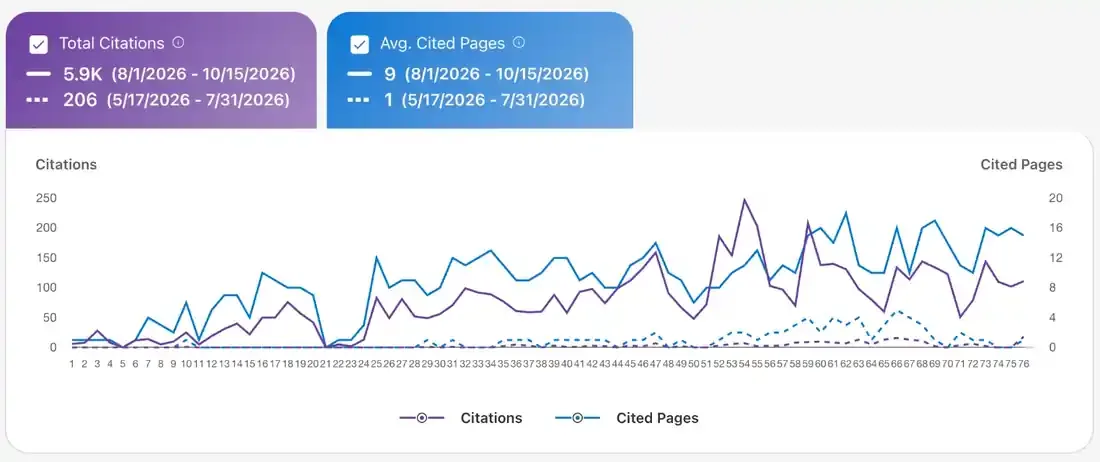
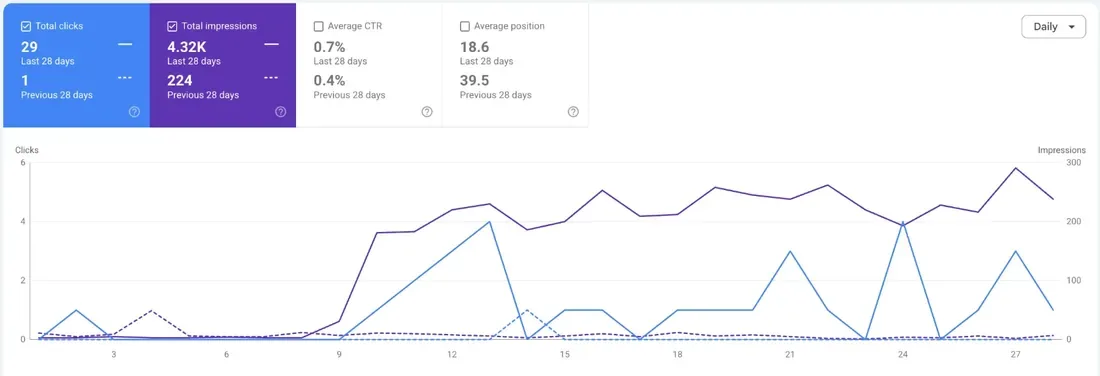
Read it honestly. The AI side moved first and fastest: within the first weeks, answer engines were citing the CRM's pages regularly, long before Google sent real click volume. On Google, impressions grew almost twentyfold and the average position more than halved, but 29 clicks is still an early-stage number. Bing also says citation counts show visibility in AI answers, not ranking, so we report them beside signups, not instead of them.
12Where Win Market Agency fits
Win Market Agency is an SEO and digital marketing agency based in Cairo, working remotely with clients worldwide. Our SEO service costs USD 500 per month, covers technical SEO, content and AI search visibility, and starts with a free SEO audit. We report in signups, leads and Search Console data, with dates on every screenshot.
The SaaS case above is our most recent. Outside SaaS, a site that lost 21,000 keywords in 30 days while its link count kept rising went from 54,900 to 102,000 ranking keywords after our work, and from 777 to 4,300 top-three keywords (case study). Run the checks in this guide on us too, then ask for the free audit.
?Frequently asked questions
Is SEO worth it for SaaS?
Yes, for most SaaS products with real search demand, because organic signups keep arriving without a cost per click, which lowers blended CAC over time. It is slower than paid ads, so it works best alongside them rather than as a replacement in the first months.
How long does SaaS SEO take to work?
Bottom-funnel pages such as comparisons and integrations can start bringing signups within a few months on an established domain. A new domain or a large content programme takes longer. Google does not publish a timeline, and no one can guarantee a ranking.
What is a good SaaS SEO strategy for a startup?
Fix tracking and rendering first, then build comparison, alternatives and integration pages, because those searches come from buyers ready to try a product. Add product-led tutorials and templates next, and scale templated pages only after a small pilot proves they get indexed and convert.
Is programmatic SEO safe for SaaS?
It is safe when each page gives unique, useful information for a real search, such as genuine integration details. Google's spam policies treat generating many pages mainly to manipulate rankings as scaled content abuse, whether people or AI write them.
How does SEO reduce CAC for SaaS?
Blended CAC is total acquisition spend divided by all new customers. As organic customers grow while paid spend stays flat, the average cost per customer falls. Count content, development and tools as SEO costs so the comparison is fair.
How much does SEO for SaaS cost?
Market prices vary widely. Win Market Agency charges USD 500 per month for SEO, and the first SEO audit is free.
Want to know what's holding your site back?
Get a free SEO audit: where you rank, what's blocking you on Google and in AI answers, and what to fix first. SEO is USD 500 a month, and the audit is free.
Sources
- Introducing AI Performance in Bing Webmaster Tools Public Preview — Microsoft Bing Blog
- Spam policies for Google web search — Google Search Central
- Understand the JavaScript SEO basics — Google Search Central
- Creating helpful, reliable, people-first content — Google Search Central
- Do you need an SEO? — Google Search Central
- Add a website property to Search Console — Search Console Help
- Mark events as key events — Google Analytics Help